


Was King Charles III's Vatican Meeting a Royal Forerunner? How the Pope-King Encounter May Be Paving the Way for Anglican-Catholic Rapprochement Under Archbishop Sarah Mullally
 |
| Photo: AP/Andrew Medichini |
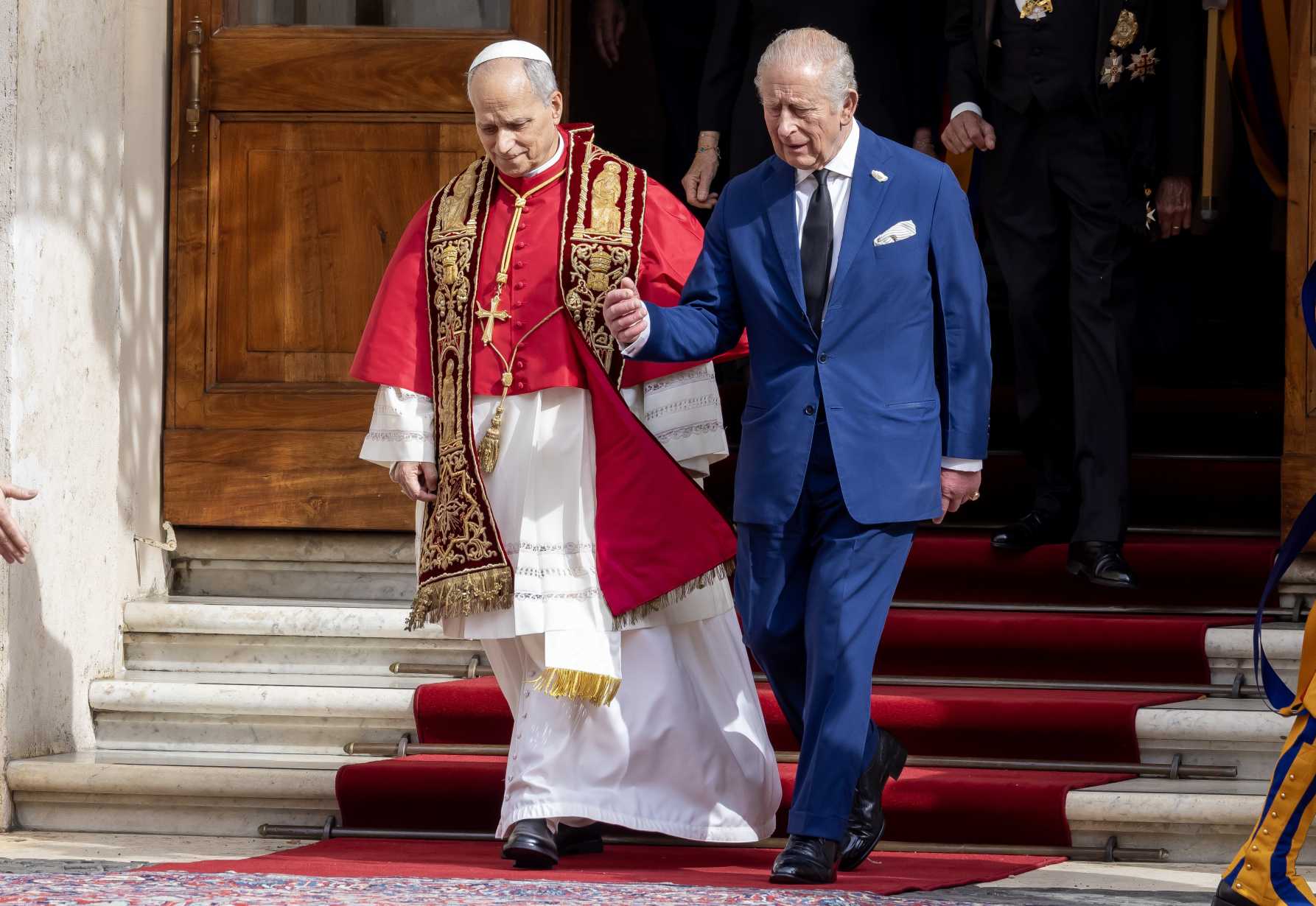
When King Charles III stepped into the Vatican's Apostolic Palace on October 23, 2025, to meet the newly elected Pope Leo XIV, few observers could have anticipated just how layered that moment truly was. On the surface, it was a historic state visit — the first time in over 500 years that a reigning British monarch and a pope had prayed together publicly, doing so beneath Michelangelo's timeless ceiling in the Sistine Chapel. But beneath the ceremonial splendour, a more intriguing question lingers: was the King, in his dual role as Britain's head of state and Supreme Governor of the Church of England, quietly laying the groundwork for a new season of Anglican-Catholic relations — one that could gain fresh energy under the newly installed Archbishop of Canterbury, Dame Sarah Mullally?
King Charles and Pope Francis, April 2025
The story actually begins several months earlier and with a different pope. King Charles III and Queen Camilla made a four-day state visit to Italy in April 2025, coinciding with their 20th wedding anniversary. The official state visit to the Vatican had originally been planned as a formal occasion during the Holy Year 2025, but the visit was postponed by mutual agreement as Pope Francis recovered from more than five weeks of inpatient treatment for breathing difficulties, double pneumonia and a polymicrobial infection.
Even so, the encounter was not abandoned. Pope Francis met privately with King Charles and Queen Camilla, expressing best wishes to Their Majesties on the occasion of their wedding anniversary and reciprocating the King's wishes for a speedy recovery of his health. It was a quietly human moment between two men who each understood the weight of serious illness — Charles was on his first trip abroad that year after being hospitalised over side effects related to his ongoing cancer treatment.
Before the Vatican visit, King Charles became the first British monarch to address a joint session of the Italian parliament, where he stressed the need for close ties and unity in the defence of common values. And in the days before the private audience with the ailing Pope Francis, Charles publicly prayed for Pope Francis while meeting representatives of various faiths at a garden party at the British ambassador's residence, saying simply, "I pray for the pope."
It was a gesture that carried more than diplomatic weight. It was the language of shared faith.
October 2025, History Made in the Sistine Chapel
 |
| Photo:Aaron Chown/Pool/AFP via Getty Images) |
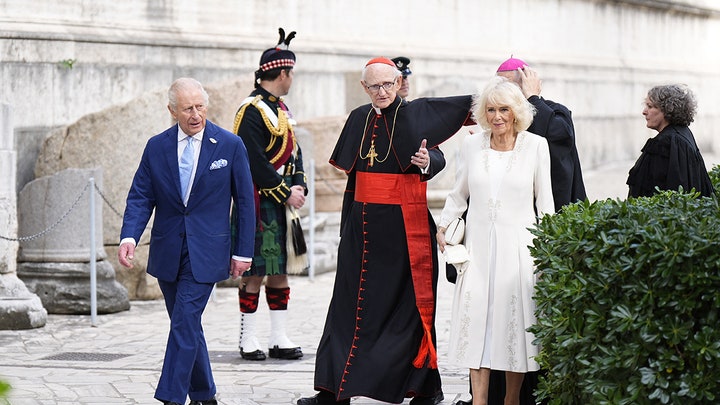
When Pope Francis passed away in the weeks that followed and Pope Leo XIV was elected, the formal state visit that had been postponed was rescheduled. What took place on October 23, 2025, was nothing short of historic.
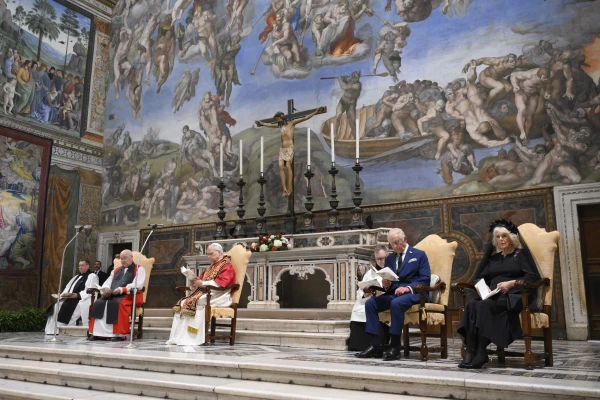
Pope Leo XIV and Britain's King Charles III made history by being the first pontiff and British monarch to pray together at the Vatican in more than 500 years — celebrating improved Catholic-Anglican relations and a shared commitment to Christian unity and care for the environment.
The day was rich with symbolism and substance. After a private meeting in the Apostolic Palace, Pope Leo and King Charles left the Sistine Chapel together and went into the adjoining Sala Regia to meet business leaders and activists committed to fighting climate change and promoting sustainability.
More remarkably, King Charles was conferred the title of "Royal Confrater" of the Papal Basilica of St. Paul Outside the Walls — a gesture described as one of "hospitality and ecumenical welcome." In return, with the approval of the King, Pope Leo XIV accepted the offer to become "Papal Confrater" of St. George's Chapel at Windsor Castle — mutual gifts described as "recognitions of spiritual fellowship" and "deeply symbolic of the journey" of the Church of England and the Catholic Church.
A specially commissioned chair was installed in the Basilica for the King, decorated with his coat of arms and a verse from the Gospel of John in Latin: "Ut unum sint" — "That they may be one."
It is difficult to look at that inscription and not wonder whether someone, somewhere, was thinking beyond the state visit.
Father Martin Browne, an official of the Vatican's Dicastery for Promoting Christian Unity, captured the spirit of the day pointedly. He explained that the King "clearly wished to express a closeness that he believes already exists and to make that concrete and visible," adding: "I think on both sides it's about recognizing that, even though there are remaining divisions between our churches — very serious ones on all kinds of issues that we work on in our various theological dialogues — there is a huge amount of common ground, of shared faith, of shared spiritual tradition."
Archbishop Sarah Mullally: A Historic — and Contested — Appointment
 |
| Photo:The Living Church |
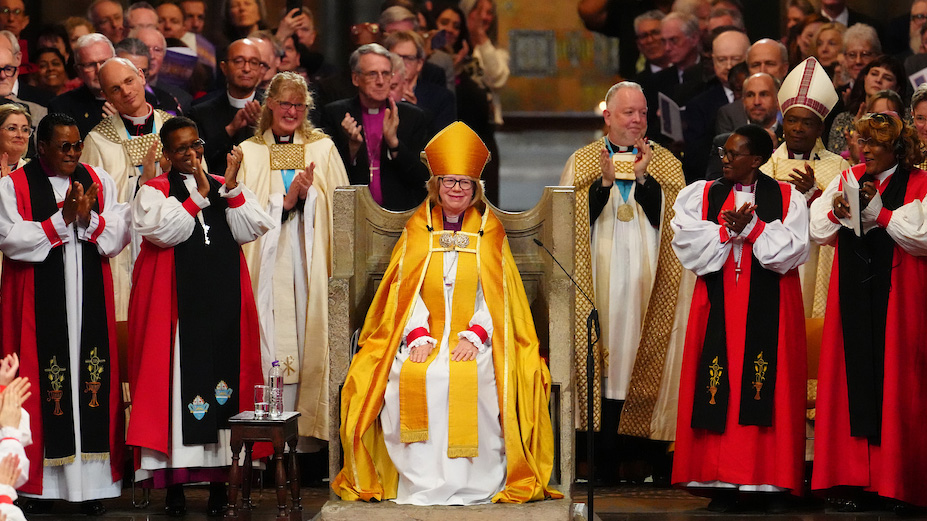
Just days before that October Vatican meeting, the Church of England made an announcement of its own: Dame Sarah Mullally would become the next Archbishop of Canterbury, the first woman to hold the post in the Church's history. Her appointment, made with the approval of King Charles, was celebrated by many but received with significant tension within the broader Anglican Communion.
The Global Fellowship of Confessing Anglicans (GAFCON) received the announcement "with sorrow," stating that the Church of England had "chosen a leader who will further divide an already split Communion." The churches belonging to GAFCON, representing a significant portion of Anglicans worldwide — largely in Africa and Asia — subsequently announced they would not participate in meetings convened by the new Archbishop.
Dame Sarah was formally installed at Canterbury Cathedral on 25 March 2026, marking the beginning of her public ministry in the role. In her first sermon, she reflected on her unexpected journey of faith, saying: "As I look back over my life — at the teenage Sarah, who put her faith in God and made a commitment to follow Jesus — I could never have imagined the future that lay ahead, and certainly not the ministry to which I am now called."
A Letter "In Truth and Love"
 |
| Photo: CNS/Vatican Media |
What happened next is where the threads of the King's Vatican visits and the new Archbishop's installation begin to weave together into something potentially significant.
Pope Leo XIV sent a personal message to Archbishop Mullally on the occasion of her installation, assuring her of his prayers and invoking "grace, mercy, and peace… in truth and love."
The Pope did not sidestep the complexity of the moment. He acknowledged the difficulties along the ecumenical journey, citing the 2016 Joint Declaration signed by Pope Francis and Archbishop Justin Welby, which noted that "new circumstances have presented new disagreements among us." Yet his tone was one of determined engagement rather than retreat. He insisted: "We need to continue to dialogue in truth and love, for it is only in truth and love that we come to know together the grace, mercy, and peace of God."
Archbishop Mullally responded warmly, writing: "I am deeply grateful for your gracious letter, and for the assurance of your prayers at the time of my installation as Archbishop of Canterbury." She added: "As Archbishop of Canterbury, I too am called to serve as an instrument of communion within the Anglican Communion, and to seek the full and visible unity to which our Lord has called us all."
Notably, Lambeth Palace confirmed that Archbishop Mullally will visit Rome from 25–28 April, during which she will meet with Pope Leo XIV at the Vatican. This visit — coming so rapidly after her installation — is itself a signal.
The Theological Elephant in the Room
None of this, however, papers over the very real and very deep theological differences between Rome and Canterbury. The Vatican's position on several Anglican practices is not a matter of preference — it is, in Catholic teaching, a matter of doctrine.
On the question of Anglican holy orders, the Catholic Church's position has been clear since Pope Leo XIII's 1896 declaration Apostolicae Curae: the official position of the Catholic Church is that ordination to the priesthood according to the Anglican rite is invalid. This is not merely a historical footnote. It shapes how Catholics understand whether Anglican clergy are, in the sacramental sense, priests at all.
On the matter of women's ordination — a practice the Church of England now extends even to its highest office — the Vatican position is equally unambiguous. Pope Francis stated clearly in 2013 that "the Church has spoken and says 'No'" to the ordination of women, calling it a "definitive formulation" — "that door is closed."
The appointment of a woman as Archbishop of Canterbury therefore lands squarely in one of Catholicism's most firmly held theological positions. Rome is not simply disagreeing with a Church of England policy — it is confronting a development that, from the Vatican's doctrinal standpoint, deepens the question of whether Anglican orders can be considered valid at all.
And yet — and this is the remarkable thing — Pope Leo XIV still sent that letter. Cardinal Kurt Koch, the Vatican's top ecumenism official, still travelled to Canterbury Cathedral to deliver it in person. The dialogue continues.
Was the King a Forerunner? A Suggestive Reading of Recent Events
It is worth stepping back and reading the sequence of events as a possible narrative arc.
King Charles, as Supreme Governor of the Church of England, visited Pope Francis privately in April 2025 — a quiet, personal, bilateral encounter. He then made the historic October visit to Pope Leo XIV, complete with joint prayer in the Sistine Chapel, the exchange of confraternal honours, and an inscription urging unity. All of this was framed not as a political exercise but — as Father Browne of the Dicastery for Promoting Christian Unity put it — as an expression of a spiritual closeness the King "believes already exists."
Days later, a new Archbishop of Canterbury was announced — one whose theology of inclusion and track record of pastoral openness represents a markedly different posture from some of her predecessors. And then, within months of her installation, an exchange of letters and a planned meeting in Rome.
Could it be that Charles — a king who attends canonisations, prays publicly for popes, and insists on a "spiritual dimension" to state visits — was, consciously or not, warming the ground? That his embodied ecumenism, conducted at the level of personal relationship, has helped create a climate in which the Vatican felt it could reach out warmly to a first female Archbishop, even while holding firm to the doctrines that make her very office theologically complicated from Rome's perspective?
It is, at the very least, a compelling suggestion.
What Could Cooperation Look Like?
The idea of full communion between the Anglican and Catholic churches remains — to put it carefully — a distant horizon. The theological barriers are not cosmetic. The invalidity of Anglican orders, the ordination of women, different understandings of the papacy, and now the growing Anglican divisions over sexuality and marriage all represent genuine fracture lines.
But cooperation does not require full communion. The Dicastery for Promoting Christian Unity underlined that the shared ground between the two churches — "of shared faith, of shared spiritual tradition" — is substantial and real.
Pope Leo has pointed to the work of the Anglican-Roman Catholic International Commission (ARCIC) as having "contributed to greater mutual understanding" and enabled a more effective common witness in the face of contemporary global challenges. On climate, on poverty, on the dignity of human life — the two churches already speak with remarkable coherence.
The Pope's message also offered an ecumenical theology grounded not in doctrinal agreement but in something more fundamental: "differences cannot prevent us from recognizing one another as brothers and sisters in Christ by reason of our common baptism," Pope Leo wrote. That is not a concession on doctrine. But it is an open door.
Archbishop Mullally's planned April visit to Rome will be closely watched. It is too soon to say whether it will produce any new formal commitments. But the mere fact that a newly enthroned Archbishop of Canterbury — the first woman to hold that office — is being received by a pope who explicitly expressed his commitment to continuing dialogue is itself a statement.
A Season of Openness, Not Resolution
The road between Rome and Canterbury has always been long, and the theological landscape between them remains, in places, impassable. The Vatican will not — cannot, in its own doctrinal framework — simply set aside its positions on Anglican orders or the ordination of women to accommodate the moment.
But history rarely moves in straight lines. It moves through relationships, gestures, letters, and the slow accumulation of shared prayers. King Charles III, with his quiet and persistent habit of showing up — at canonisations, at hospitals, in chapels, in the Sistine Chapel itself — may have done something more significant than statecraft. He may have reminded both sides that the conversation is worth having.
And now Archbishop Sarah Mullally, bearing a role no woman has ever held in the 1,400-year history of the Church of England, is preparing to walk into that same Vatican that, doctrinally, does not yet recognise the validity of what she is. That she is going — and that she is being welcomed — says something. What exactly it says, history will have to decide.
For now, the doors are open, the kneelers are shared, and the Latin inscription in St. Paul's Basilica still reads: Ut unum sint — that they may be one.
.png)



No comments:
Post a Comment