


U.S. Seizes Nearly $1 Billion in Iranian Crypto: Inside Operation Economic Fury
How the Treasury Department turned blockchain transparency into a weapon against sanctioned elites — and why your Bitcoin isn’t as anonymous as you think.
 |
| Image Credit: Inquesta FORENSIC |
~$1B Total crypto seized As of May 2026 | $344M Largest single action | 1,000+ Entities sanctioned Since Feb 2025 (OFAC) | Mar 2025 Operation launched Trump executive order |
The Paradox Bitcoin is often compared to digital cash — untraceable, ungovernable, beyond the reach of any government. That reputation has made it a favorite tool of sanctioned regimes, money launderers, and illicit arms dealers. It has also, time and again, proven catastrophically wrong. When U.S. Treasury Secretary Scott Bessent stepped in front of cameras on May 29, 2026, and announced that the United States had seized nearly one billion dollars in Iranian cryptocurrency, he was describing not just the largest crypto enforcement action in history — he was demonstrating that blockchain's defining feature, its immutable public ledger, is law enforcement's best friend. |
Operation Economic Fury, ordered by President Trump in March 2025, has targeted Iran’s financial lifelines through a combination of asset seizures, frozen bank accounts, secondary sanctions, and aggressive coordination with foreign governments and crypto firms. The total haul has climbed past $500 million in confirmed seizures — and Bessent’s most recent remarks suggest the running total is approaching $1 billion. The operation’s biggest single blow came on April 23, 2026, when stable coin issuer Tether froze $344 million in USDT held across two Tron blockchain wallets linked to Iran’s Islamic Revolutionary Guard Corps (IRGC). One wallet alone held $213 million; the other, $131 million.
The message from Washington was unambiguous: “Anonymous until Treasury gets informed.” And Treasury, it turns out, gets very well informed.
The Operation
 |
| Image Credit: Yahoo Finance |
Operation Economic Fury was formally launched in March 2025 by executive order, tasked with cutting off what Bessent called Iran’s “international shadow banking infrastructure.” Since February 2025, OFAC has sanctioned over 1,000 Iran-related persons, vessels, and aircraft. The campaign is simultaneous and multi-fronted:

• Crypto asset seizures: The Treasury targeted stable coin wallets linked to IRGC oil revenues and elite fund managers. The April 2026 Tether freeze of $344M in USDT was the largest single crypto enforcement action in the operation’s history.
• Shadow banking networks: On a single Tuesday, OFAC sanctioned 35 entities and individuals tied to Iran’s shadow banking network.
• Shadow fleet: Roughly 40 shipping firms and a Chinese oil refinery operating as part of Iran’s crude oil trade were targeted.
• Weapons procurement: 14 individuals and entities were sanctioned for procuring components for Shahed-series drones and ballistic missile propellants.
• Overseas real estate: The U.S. is working with European allies to seize “villas, houses, and properties” held by Iranian officials abroad.
Before the operation intensified, Bessent estimated the regime was siphoning $400 to $500 million every month through crypto channels, splitting the proceeds among dozens of senior leaders. Iran had relied especially on USDT stable coins on the Tron blockchain to move funds from oil sales and IRGC operations — a channel that is now being systematically closed.
Anonymity vs. Transparency: How Treasury Traces Crypto
 |
| Image Credit: The Defiant |
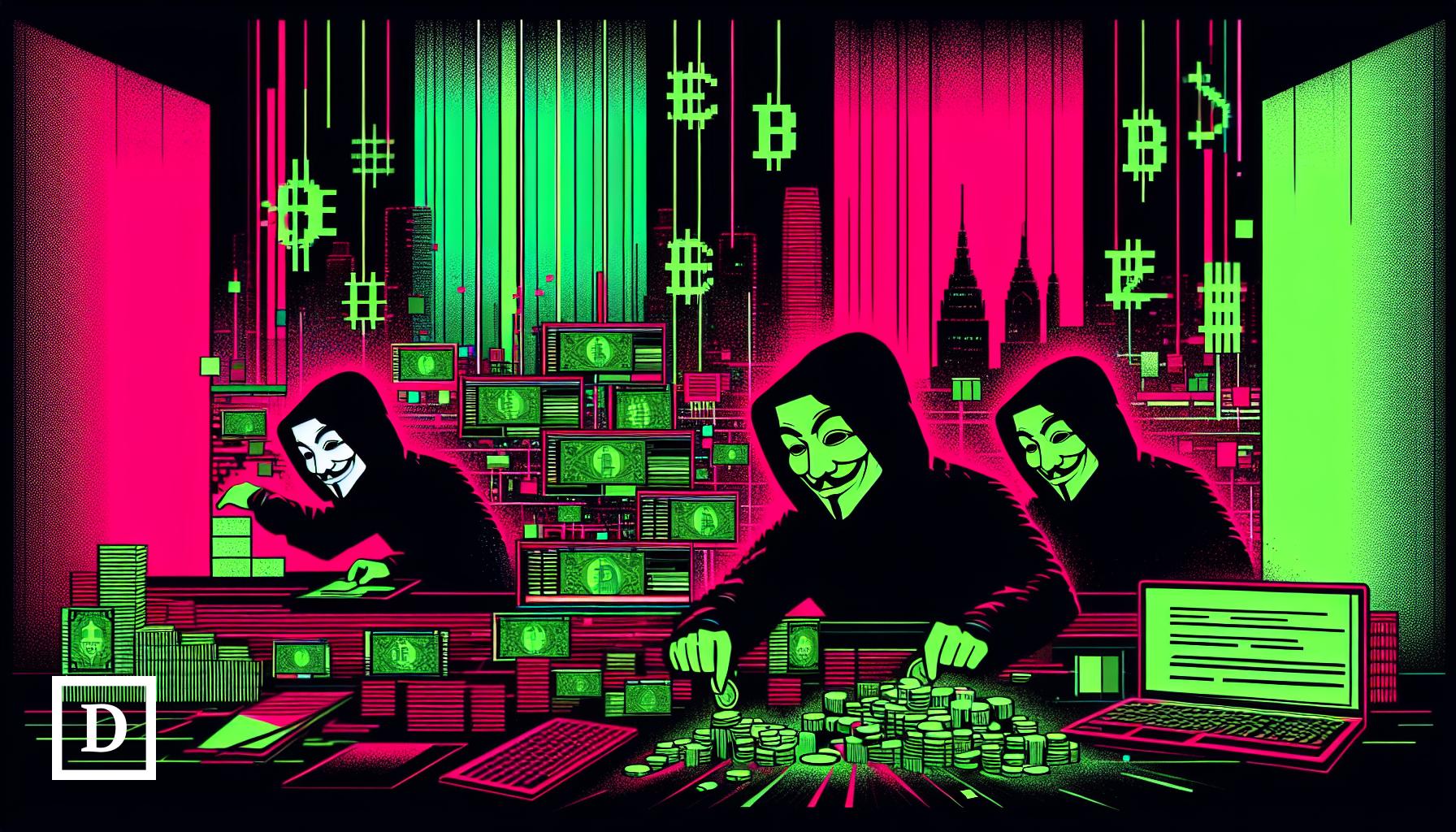
BLOCKCHAIN 101 A blockchain is a public ledger where every transaction is permanently recorded and visible to anyone. Wallet addresses — the ‘accounts’ on a blockchain — are pseudonyms: you can see exactly what each address sends and receives, but you don’t automatically know who controls it. That gap between pseudonymous address and real identity is precisely what investigators exploit. |
The de-anonymization process runs in layers:
• Exchange KYC checkpoints: When a wallet transacts with a regulated exchange, that exchange has collected Know Your Customer (KYC) identity data. A subpoena or formal request can link the wallet address to a real individual.
• Chain analytics: Firms like Chainalysis and Elliptic apply transaction clustering — grouping addresses that consistently transact together, share inputs, or display patterns consistent with a single controlling entity. Once one address in a cluster is identified, others become traceable.
• Mixer/tumbler detection: Mixers route funds through multiple intermediary wallets to obscure origin. But the patterns they create — timing, fee structures, fragmentation sizes — are now recognizable to analytic algorithms. Treasury can follow ‘washed’ crypto forward even after multiple hops.
• Stable coin blacklisting: Unlike Bitcoin or Ether, stable coins like USDT are issued by a private company (Tether). When OFAC adds a wallet to the Specially Designated Nationals (SDN) list and alerts Tether, the issuer can invoke a deny-list function to freeze the wallet directly — without requiring a court order to seize funds from an exchange. This is why the April 2026 action was so swift.
 |
| Image Credit: Magazine Blog Insights |
Bitcoin and Ether cannot be ‘frozen’ at the protocol level. But the enforcement approach for those assets works through custodians: any U.S.-regulated exchange or custodian holding those assets for a sanctioned address is legally required to block access, deny transactions, and report the blocked property to OFAC within 10 business days.
The analogy that captures it best: Bitcoin is less like anonymous cash and more like writing your account number on a billboard. The missing piece is connecting the billboard to a name — and Treasury has become very good at making that connection.
Legal and Geopolitical Context
The legal architecture behind Operation Economic Fury is built primarily on the International Emergency Economic Powers Act (IEEPA), which grants the President broad authority to regulate transactions during a declared national emergency. OFAC’s enforcement authority under this framework is far-reaching: it applies to all U.S. persons and entities, and to any transaction that touches U.S. financial infrastructure — which, in practice, includes most international dollar-denominated activity.
For foreign exchanges and financial institutions, the incentive to comply is the threat of secondary sanctions: entities that continue doing business with designated Iranian parties risk being cut off from the U.S. financial system entirely. The U.S. has shared intelligence with China, Hong Kong, the UAE, and Oman, identifying banks that have allegedly enabled Iranian activity and warning that continued cooperation could trigger secondary sanctions.
Critically, Operation Economic Fury explicitly targets the regime’s leadership and its affiliated military enterprises — particularly the IRGC and its network of front companies — rather than ordinary Iranians. Assets are held, according to Bessent, “on behalf of the Iranian people,” with some subject to claims from terrorism victims.
What This Means for Crypto Users

For ordinary cryptocurrency holders, Operation Economic Fury carries several implications:
• Centralized exchange risk: Crypto held on a regulated exchange is subject to U.S. law. If an exchange freezes an account due to OFAC review, even an uninvolved user could experience access delays while compliance checks are completed.
• Stable coin exposure: USDT and USDC can be frozen at the issuer level with no recourse from the holder. Users who rely on stablecoins for large balances accept issuer-side counterparty risk.
• The limits of self-custody: Hardware wallets protect against exchange risk, but do not protect against blockchain analytics identifying wallet addresses through transaction history.
• Code vs. law: Decentralization limits government control at the protocol level, but not at the human chokepoints — exchanges, on-ramps, KYC providers, and stable coin issuers — where most users interact with crypto.
Conclusion
Operation Economic Fury is likely to become a template. The combination of OFAC SDN designations, proactive outreach to stable coin issuers, blockchain analytics firm partnerships, and secondary-sanctions pressure on foreign intermediaries represents a new model for financial warfare — one that works with the blockchain’s transparency rather than against it.
The blockchain records everything. It forgets nothing. And the moment a sanctioned wallet touches anything connected to the regulated financial system, that permanent record becomes a prosecution brief. Cryptocurrency, it turns out, is anonymous until it isn’t — and for the Iranian regime, it very much isn’t.
Disclaimer @Magazine Blog Insights 2026, Your Media Information Blog. Information doesn't constitute financial advice, don't be coerced!
.png)



No comments:
Post a Comment